
Surrendering to Gods Plan Learning Trust and Strengthening Faith
Surrender sounds peaceful until God asks for the thing we have been gripping the hardest.
It is easy to say, “Lord, have Your way,” when life feels steady. It is much harder when the road bends, the timing changes, or the answer looks different from the one we prayed for. That is where surrender becomes real. It moves from a phrase we say to a posture we live.
For me, this season has felt like learning to navigate all over again. I used to think the navigator’s job was to read the map, choose the route, and keep everything on schedule. Now I am learning that faith asks for something deeper. The true work of the navigator is not control. It is trust.
God is teaching me to loosen my grip on the wheel, listen for His direction, and believe that His plan is still good even when I cannot see the full road ahead.

Surrender is not giving up
Many people hear the word surrender and think it means quitting. In faith, surrender is not defeat. It is not passive. It does not mean we stop praying, stop planning, or stop caring.
Surrender means we stop pretending we are God.
That can be confronting. We like answers. We like timelines. We like signs that everything will work out before we take the next step. Yet the life of faith rarely gives us the whole map at once. More often, God gives enough light for the next faithful step.
Surrender is active trust. It is waking up and choosing obedience when the outcome still feels uncertain. It is praying with honesty, then leaving room for God to answer in His wisdom. It is doing what is right in front of us while trusting Him with what is beyond us.
The navigator in me is learning this slowly. I can study the conditions. I can prepare. I can make wise choices. But I cannot command the wind. I cannot control the weather. I cannot see every hidden turn. That knowledge used to make me anxious. Now, by grace, it is teaching me dependence.
There is freedom in admitting, “Lord, I do not know the way, but I trust You do.”
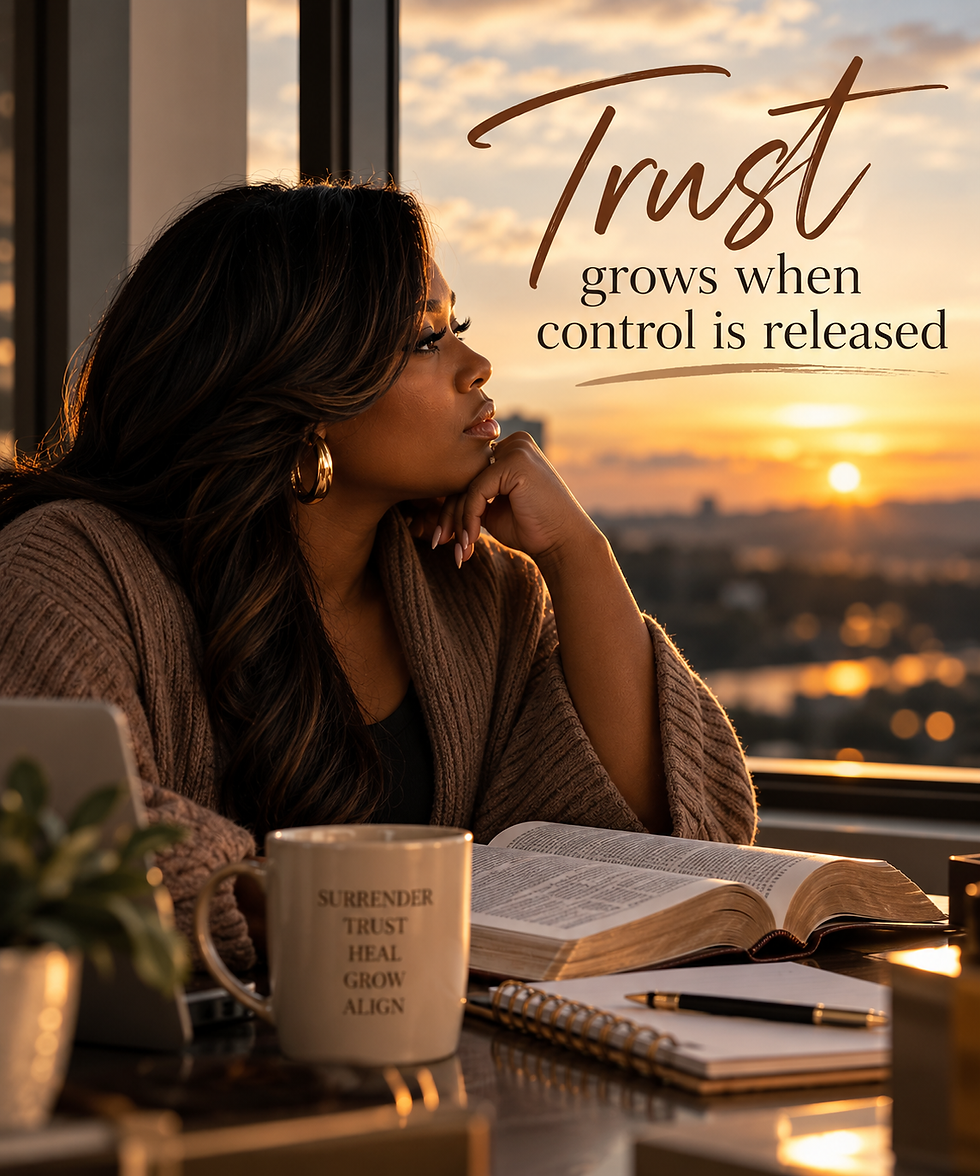
Trust grows when control is released
Trust does not usually grow in comfort. It grows in the places where control has reached its limit.
There are moments when we do everything we know to do, and the result still sits outside our hands. A door closes. A prayer seems delayed. A relationship shifts. A plan falls apart. We reach for certainty and find none.
That is often where God begins a deeper work.
The question changes from, “How do I fix this?” to, “God, who are You asking me to become in this?” That question does not remove the weight, but it changes the way we carry it.
Trust grows when we remember God’s character more than our circumstances. He is not careless with our lives. He is not confused by what confuses us. He is not late, even when we feel like we have been waiting too long.
This does not mean every season feels good. Faith does not ask us to pretend pain is pleasant. We can be honest with God. We can bring Him disappointment, fear, grief, and frustration. The Psalms show us that raw prayers still belong in a faithful life.
Real surrender sounds like this:
“God, this is not what I expected. I do not understand it all. But I believe You are still good, and I am willing to follow You from here.”
That kind of prayer may not change the situation straight away. It changes the heart first. It creates space for peace to enter, not because everything is resolved, but because God is present.
Faith increases through daily obedience
We often want faith to grow in one large moment. Sometimes it does. More often, faith strengthens through small choices repeated over time.
Choosing to pray before reacting.
Choosing to forgive when pride wants the final word.
Choosing to wait without becoming bitter.
Choosing to keep showing up when progress feels slow.
Choosing to obey what God has already made clear.
These quiet choices matter. They become the training ground where trust is built. Like a navigator learning to read the stars, we begin to recognise God’s guidance more clearly by walking with Him day after day.
Faith is not only built in church services or big spiritual moments. It grows in kitchens, cars, hospital rooms, workplaces, classrooms, and quiet bedrooms late at night. It grows when we pause before making a decision and ask, “Lord, is this the way You want me to go?” It grows when we open Scripture and let truth correct our fear. It grows when we choose peace instead of panic.
Increasing faith is often less about feeling brave and more about returning to God again and again.
Some days, faith feels strong. Other days, it feels like a whisper. Both days can still be faithful days if we turn towards God.
A helpful rhythm can be simple:
Begin the day with surrender “God, this day belongs to You.”
Ask for guidance before decisions “Lead me in wisdom and peace.”
Notice fear without obeying it “I feel afraid, but fear will not be my guide.”
End the day with trust “What I could not finish, I leave with You.”
These small prayers shape the soul. They remind us that we are not alone, and we are not carrying life by ourselves.
God’s plan may not match our preference
One of the hardest parts of surrender is accepting that God’s plan may not look like our preferred plan.
We may pray for speed and receive patience. We may pray for clarity and receive one small step. We may pray for open doors and receive a quiet season of preparation. We may pray for comfort and receive growth.
This can feel confusing, especially when our desires are good. Wanting healing, direction, stability, provision, or restoration is not wrong. God cares about those things. Yet His wisdom reaches further than our immediate relief.
A loving parent does not always give a child what they ask for in the moment. Not because the parent is cruel, but because love sees more than the child can see. In a far greater way, God’s love is not limited to our current understanding.
The navigator in me is learning that a detour is not always a denial. Sometimes it is protection. Sometimes it is preparation. Sometimes it is God leading me away from something that looked right but was not good for where He is taking me.
That truth is humbling. It asks me to release the need to understand everything before I obey.
Proverbs 3 reminds us to trust the Lord with all our heart and not lean only on our own understanding. That is not a call to switch off our minds. It is a call to place human understanding in its proper place. Wisdom matters, but God’s wisdom stands higher.

Waiting can become a holy place
Waiting often feels like wasted time. We want movement. We want answers. We want God to hurry.
Yet waiting can become one of the most sacred places in our faith if we let God meet us there.
In waiting, motives surface. Fear speaks loudly. Impatience shows itself. The desire for control becomes obvious. None of this means we are failing. It means God is revealing what He wants to heal and strengthen.
Waiting teaches us to seek God for who He is, not only for what He can give. It teaches us to value His presence as much as His provision. It teaches us that silence does not always mean absence.
There have been seasons where I wanted a clear sign, but God gave quiet reassurance instead. I wanted the full plan, but He gave daily bread. I wanted certainty, but He invited closeness.
That is where faith deepens.
The waiting room becomes a classroom. The lesson is trust. The Teacher is patient.
Surrender makes room for peace
Peace does not always arrive when the problem disappears. Sometimes peace arrives when we stop fighting God for control.
There is a difference between responsible action and anxious striving. Responsible action does what love, wisdom, and obedience require. Anxious striving tries to force outcomes that belong to God.
Surrender helps us tell the difference.
When we surrender, we can still make plans, but we hold them open-handed. We can still hope deeply, but we do not make hope depend on one exact outcome. We can still work hard, but we do not treat our effort as the source of our safety.
This kind of peace is not weakness. It is strength under God’s care.
It says, “I will do my part, and I will trust God with His.”
That sentence can steady the heart in real life. Before the appointment. Before the conversation. Before the move. Before the decision. Before the answer comes.
Peace grows where surrender is practised.
The navigator is still learning
I wish I could say surrender always comes naturally now. It does not. Some days I still reach for control. Some days I still want God to explain every turn before I take another step.
But I am learning.
I am learning that faith is not proved by never feeling uncertain. Faith is shown when uncertainty does not stop obedience.
I am learning that God can be trusted with both the destination and the delay.
I am learning that the safest place is not the place where I feel most in control. The safest place is wherever God is leading.
I am learning that His plan is not always the easiest road, but it is always the road where He walks with me.
That changes everything.
The role of the navigator is being reshaped. I am not the captain of my own destiny. I am a follower of a faithful God. My job is to listen, trust, adjust, and keep moving with Him.

A prayer for surrender
Lord, I give You the plans I keep trying to control.
I give You my timelines, my fears, my questions, and my need to know every detail. Teach me to trust You when the road is clear and when it is not. Strengthen my faith in the waiting. Help me obey the next step without demanding the whole map.
Remind me that Your plan is good because You are good.
Make me a faithful navigator, not one who tries to take Your place, but one who listens for Your direction and follows with courage.
Amen.
Surrendering to God’s plan is a daily choice, not a one-time moment. Some days it will feel peaceful. Some days it will feel costly. Yet every surrendered step becomes part of a deeper journey with Him.
The more we trust, the more our faith grows. The more our faith grows, the more we learn that God was never asking us to carry the whole journey alone. He was inviting us to walk with Him.


Comments